


























It is a less heard word from companies that “Employees or Teams are what makes a Company”. Though there may be many other factors like management, clients, infrastructure, financing, etc., connecting them together is what a team does for a company. Hence building a resourceful and enthusiastic team marks the company’s strong establishment. The effectiveness of an organization's recruitment influences the performance and influences the building of organizational credibility. Some companies will be particular in finding the resources for them and spend more time creating lengthier recruitment processes.
Recruitment involves some investment as they search for the right talent in various talent pools. Most companies include talent acquisition or recruitment programs in their annual budget plans. So far from our associations and experience, we have noticed only a few companies are able to scale their recruitment budget on their annual budget. But, we say that this is not due to a lack of clarity, it is just the unorganized recruitment processes that are going out of line.
From the organizational perspective, there have been a lot of changes brought by the Covid crisis, making things to address before and after the pandemic. From the infrastructural changes to operational changes, we noticed drastic advancements and worst downfalls in some cases.

Read More about Resource Retaining.
Before we dive into our topic, we would like to quickly show you the topics of discussion.
Introduction.
What is a Recruitment Strategy?
Components That Make An Effective Recruitment Strategy
Creating a compelling employer brand is the foundation
Focus on Internal mobility to fill in skill gaps
Advertise where it’s really worth
Encourage Employee referrals
Use Recruitment Automation
Adopt remote interviewing
Recruitment analytics to track results
What is a recruitment strategy?
“Recruitment” is the keyword every company ranks with, not on search engine pages, but in the corporate world. These are the techniques that mark the company’s footprints in the process of assessing, attracting, recruiting, and training. It requires different strategies at each level of the recruitment funnel. How many requirements do you have and how many strategies do you build to fulfill them, make sure all are in the loop of your company’s overall objective and importantly budget.
Components That Make an Effective Recruitment Strategy
We, being tied up with different levels of organizations have noticed the recruitment behaviors of many companies of almost all levels. We say that the companies’ era can be stated before and after the global pandemic of Covid-19. Many organizations made drastic changes to their recruitment strategies and operational perspectives. And most of them are now inclined to cost-cutting measures to survive during and after the pandemic period.
This recruitment factor may not have much effect for established companies, but it is the key factor for Start-up level or growing organizations. Keeping the recruitment expenses aside, start-ups have certain advantageous sources of recruitment like social media, personal channels, and referrals.
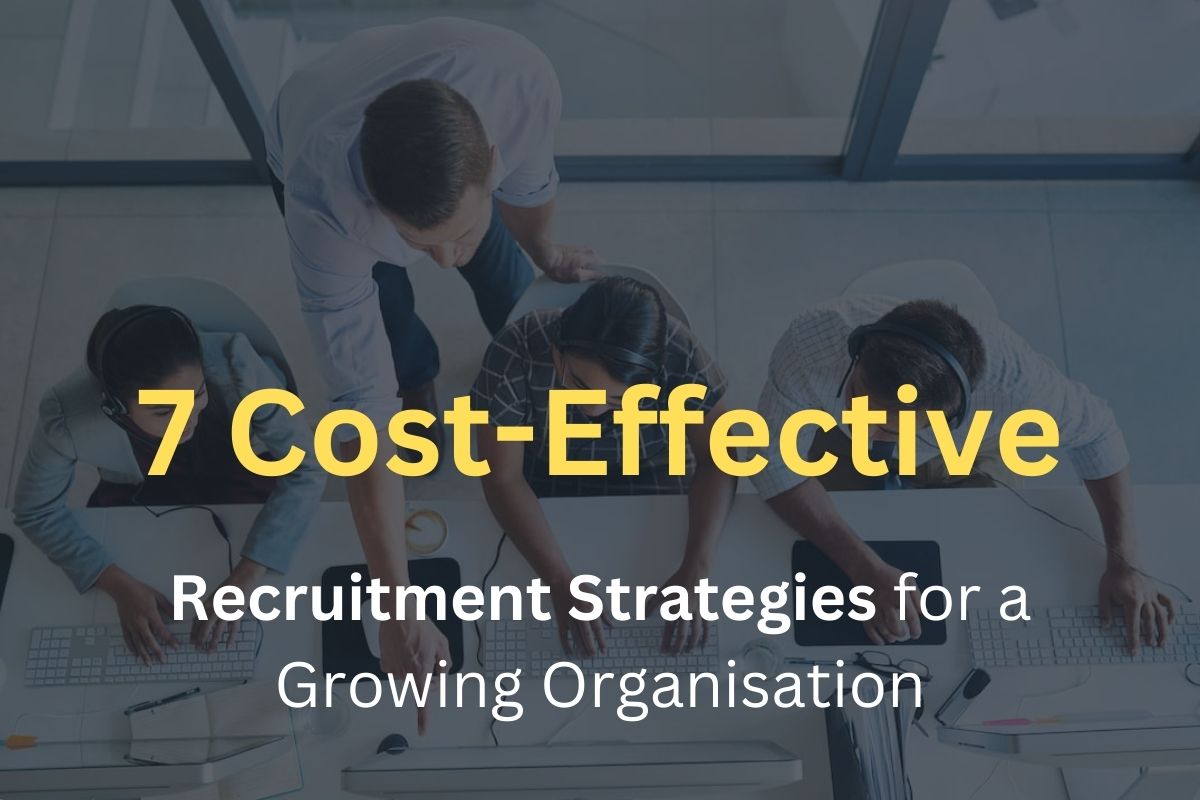
So, how can you create a successful recruitment strategy that makes the process a successful growth aspect? No worries! From our observations and relationships with different organizations, we have formulated 7 cost-effective recruitment strategies every growing organization must incorporate.
1. Creating a compelling employer brand is the foundation
Consider it’s you. Suppose you are looking for a job change or start a new career. What are the
key points you look for in any company? List them all and validate if your own company is meeting them.
Yes, it is true. Your applicants also refer for the same in your company.
The brand image of your company speaks before you speak to candidates in person. The first challenge every growing company receives is that “trust” gets associated with their career growth. Build a strong brand that tells about your mission & Vision, Goals, Objectives, and Achievements. All these define who you are to your stakeholders and job seekers. Create and promote employee spotlights. This helps job seekers know the internal operational structure of your organization. Sometimes, not only the job description but also, the work culture plays the 101th percent impact. Communicate about your workspace, work style, extracurricular activities, technology tours or trips or challenges, etc. All these make your company their desirable place to work.
2. Focus on Internal mobility to fill in skill gaps
Finding new talents is something risky and time-consuming. Even if we find it, it again takes some time to train them in their project scope. Above it, the new employee might require time to get acquainted with your work culture. And lastly here but on top in real-time, recruitment cost is to be planned from within the budget.
One of the easiest ways to overcome this is to focus on up-skilling the right candidates from your existing team. Yes, you read it right. This is called Internal Mobility.
Organize an Internal Mobility program. Start with auditing the employees and their skills, Projects and their scope, company goals, and their requirements. Once you list all these, you can figure out where you need much focus to make your company stand in front of your potential clients. This also helps in knowing the skill you are lacking in-house. If your employees are lacking behind the trending technology, pick the desirable employee and help him up-skill accordingly. Develop a strong internal recruitment policy, and encourage the employees to learn and grow. Both these acts help in retaining your employees and clients.
3. Advertise where it’s Really Worth
Today, 7 out of 10 are using social media not only for entertainment but also to get them
engaged in technology news, industry advances, and new opportunities to explore professionally and personally. It has become one of the easiest and best ways to find the right sources by right advertising the job role at the right time. To implement this, start with finding the right recruitment channels you believe will provide the correct candidate profiles matching your requirement criteria. That’s where you can smart invest your recruitment budget.
Most of the recruitment channels provide programmatic job advertising where you can only pay for the results. This in turn reduces the overall cost per applicant. In this prospect, Covid-19 helped to some extent. The labor market has changed and unemployment has grown making it easier to find applicants.
Social media networks have also become a powerful talent pool enabling applicants and employers to directly connect and hire. It is an efficient and effective platform in all aspects including cost.
4. Encourage Employee referrals
Many companies trust their employees and consider their referral profiles from them. In fact, many established companies make it a part of their recruitment process and encourage employee referrals. It is the most effective and cost-friendly method of finding qualified candidates from their own employees.
The primary advantage of this employee referral program is that your employees find the people from their circle who are clearly fit for your organization's work culture and needs. This may demand you to include beneficiary schemes for employees like bonuses, paid time off, social praise, or more for the moment, but the results will be lasting in the long run.
5. Use Recruitment Automation
Adopting automation in any way is advantageous as it saves time and manpower. In the same way recruitment automation also helps in streamlining the recruitment needs and tasks which helps to take the process effectively and also decreases the costs. Hiring the right candidates in less time is highly beneficial for growing companies.
The process of recruitment is not just finding the talents and getting them hired. It includes a lot
of internal processes right from tracking applicants, screening them, and then interviewing them for personality analysis, analyzing their skillset against requirements, conducting background checks, and then training them to match your project flow.
Carrying out these processes manually takes a lot of labor hours. Hence find the best-suited recruitment automation source and start incorporating it into your company.
Here are the 10 best applicant tracking systems you may find useful for you!
6. Adopt remote interviewing
Post Covid-19 pandemic, there is a lot to consider and employ to make it more cost-effective. Interviewing the candidates is one such procedure every company is most required to have post-Covid. Remote interviewing has regained its popularity during the Covid times as there was no chance of pool interviews.
Remote interviews lead to shorter hire time, reducing the cost of organizing and conducting interviews. Moreover, it eases the scheduling for both recruiter and the candidate. To speak the truth, around 61% of companies leverage online interviews to speed up their process and thus achieve cost-effective hiring results.
So far, we have noticed that companies have improved their cost per hire just from remote interviewing.
7. Recruitment analytics to track results
Analyzing and tracking the results of recruitment is as important as implementing a standard process. Recruitment analytics is a real game-changer that brings out the smarter ways of making an accurate recruitment plan. It derives the results in a precise manner helping to improve the quality of hire, increasing efficiency in hiring, and optimizing the recruitment costs. Choosing the right metrics helps us know the accurate checkpoints to improve and re-implement. These analytics hence assist in cost-cutting
An application tracking system helps in this prospect. They make it easier to move job descriptions across platforms and take care of posting the jobs on different platforms for better and more reliable profiles. These systems also come up with some screening questions to ease the process of candidate filtering and thus save time.
Quality of hire, Time to Hire, Cost per hire, Applicants per hire, Source of hire, Candidate experience, and hiring diversity.
To Wind Up,
Do not fly in the sky of recruitment. Wear the wings of the right strategies and accurate planning. A cost-effective recruitment strategy is not about minimizing the cost budget; it is just planning the recruitment in a way that drives the best values for the company requirements. So, be smart and precise with your recruitment strategies to make them a great asset to both company’s and employee’s growth.